How granular behind the meter & real-time household energy generation and consumption data unlocks new revenue streams, deepens customer engagement, and strengthens demand-side program management.
Executive Summary
Australia's energy transition is driving unprecedented demand for household-level data. Smart meters record interval consumption,but they tell retailers very little about what is happening inside a home, or why. Powersensor fills that gap by providing real-time, appliance-level visibility behind the meter.
Powersensor is a fully DIY, self-installed energy monitor with a retail price from $200. It captures 30-second resolution data at the site level, including gross solar generation and behind-the-meter sub-circuit monitoring for major appliances such as air conditioning, hot water systems, EVs, and pool pumps.
For energy retailers, Powersensor delivers a number of strategic advantages:
- Unmatched customer insight — granular appliance-level data that no smart meter can enable highly personalised tariff, demand-response, and switching offers for existing or potential customers
- Demand response and VPP program precision — identify and recruit the households with the highest-value flexible load (hot water, EV, air conditioning), and verify their response at the appliance level rather than just at the grid meter (Section 3.1).
- Targeted tariff, solar, battery, and electrification sales — turn generic cross-sell campaigns into individually-justified offers backed by a customer's own consumption data, with the evidence to make each offer credible (Section 3.2).
- Churn reduction through genuine engagement — customers with real-time visibility into their own energy use have more reason to stay engaged with their retailer's app and advice, reducing the appeal of switching on price alone (Section 3.3).
This white paper sets out the technical differentiation, retailer use cases, and the commercial case for making Powersensor part of your customer proposition.
1. The Data Gap Retailers Face Today
Smart Meters Are Necessary But Not Sufficient
The rollout of smart meters across Australia has been transformative, giving retailers access to 30-minute interval data for the first time. Yet this data has a fundamental limitation: it shows total consumption and export at the grid connection point, nothing more.
It cannot answer the questions that matter most for a modern retailer:
- How much of a household's solar is being self-consumed versus exported?
- Is that peak demand event driven by air conditioning, EV charging, or the hot water system?
- When does this customer's dishwasher actually run and could it shift to off-peak?
- Did the customer respond to a demand-response event, and which appliance responded?
Without answers to these questions, retailer offers, tariff recommendations, and demand programs are based on statistical inference, not individual household behaviour.
Why This Data Matters
The value of granular behind-the-meter data is not simply that it is ‘more data’, it is that it converts retailer activity from population-level guesswork into individual-level certainty. The difference matters commercially in three specific ways.
- From correlation to causation — Smart meter data can show that a customer's usage spiked at 6pm. Only appliance-level data can show that the spike was the hot water system, not the air conditioner and therefore which lever will actually change the outcome.
- From segment to individual — Demand programs and tariff offers built on demographic or regional proxies have low conversion and low response rates because they target the average customer, not the actual customer. Site-level, 30-second data allows retailers to act on what a specific household is actually doing, not what households like it typically do.
- From after-the-fact to real-time — 30-minute interval data arrives too late to inform a same-day demand event or a live customer interaction. Near real-time, 30-second data closes the loop, enabling demand response dispatch, live customer support, and in-the-moment app engagement.
In short: this is the data that makes targeted programs actually hit their targets — and the data that turns a generic energy retailer into one that can credibly say it understands each customer's home.
Alternative Ways to Access This Data — and Why Powersensor Wins on Cost and Friction
Granular behind-the-meter data is not unique to Powersensor in principle, there are other technical approaches retailers could pursue. In practice, each comes with cost, complexity, or coverage trade-offs that make fleet-wide deployment difficult.
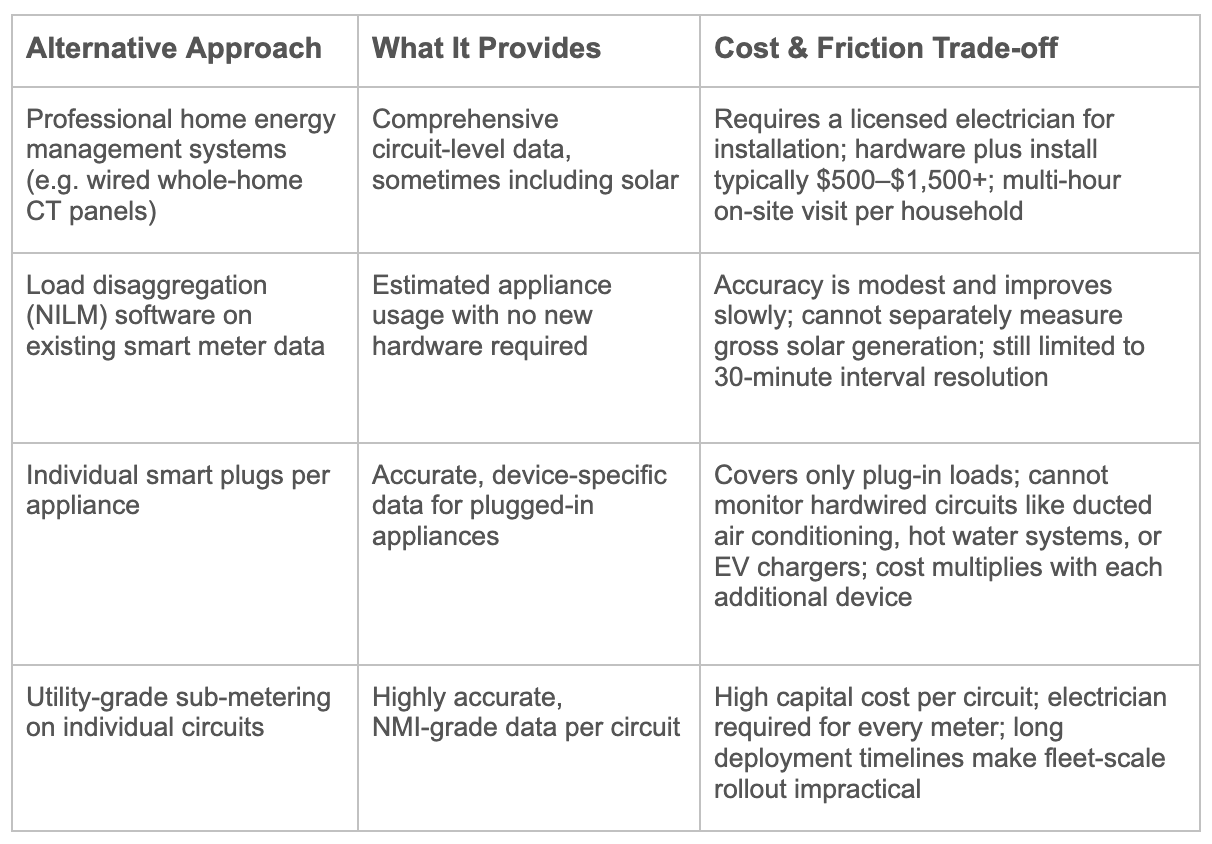
Powersensor is the only option that combines site-level consumption, gross solar generation, and major appliance circuit data in a single device. It is self-installed by the customer in under 30 minutes, with no electrician, at a retail price starting from $200. Where alternative approaches force a trade-off between coverage, accuracy, and cost, Powersensor is positioned to deliver all three at a price point and installation model that supports rollout across an entire customer base, not just a pilot cohort.
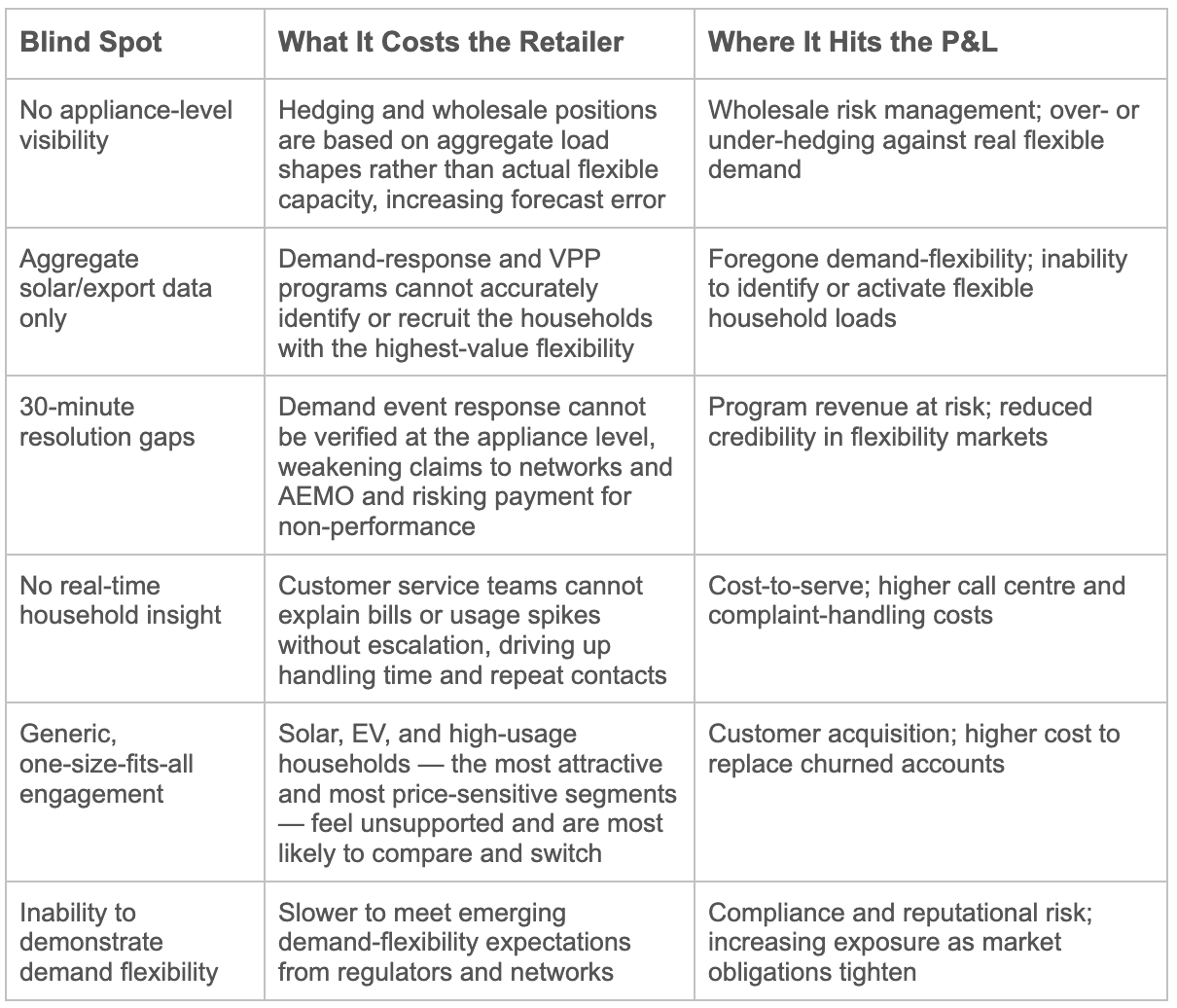
The Cost of Flying Blind
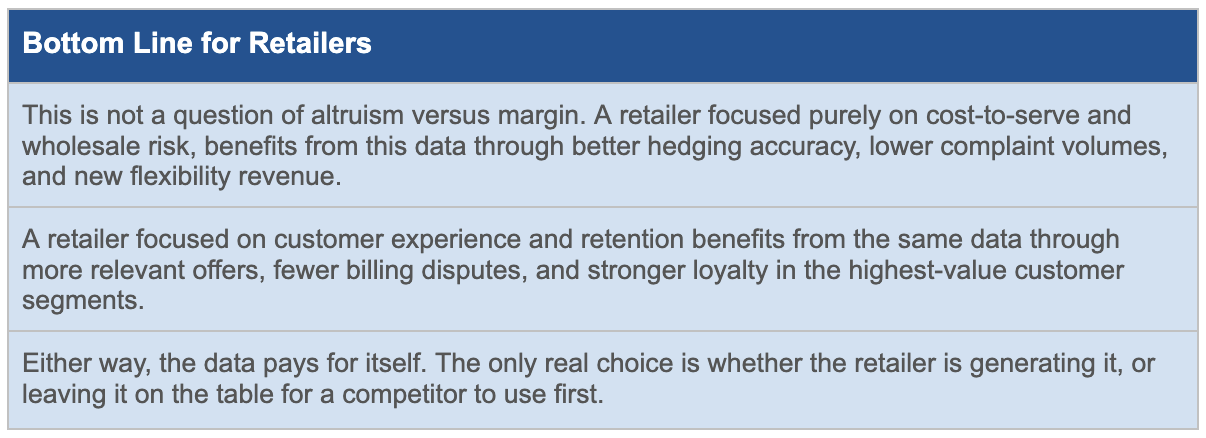
The case for this data does not depend on a retailer's strategic posture. Whether a retailer competes primarily on price and margin discipline, or on customer experience and brand trust, the absence of behind-the-meter visibility shows up as a direct cost on the P&L, not just a missed opportunity to ‘do good’.
2. What Makes Powersensor Different
2.1 30-Second Resolution — The Right Granularity
Powersensor captures data every 30 seconds, providing sufficient resolution to accurately identify individual appliance signatures, rather than just overall trends.
This level of detail is sometimes associated with grid operations, such as frequency response, network constraint management, and the like. For retailers, its value is different and arguably more direct. It provides the resolution needed to run retail programs, support customers, and make commercial decisions at the level of an individual account, rather than a network feeder.
Many high-value appliances, including reverse-cycle air conditioners, EV chargers, and hot water heat pumps, cycle their compressor load rapidly. A 5-minute average smooths these signatures into a flat line. At 30 seconds, they are clearly visible, can be attributed to a specific appliance, and are immediately usable in a retail workflow.
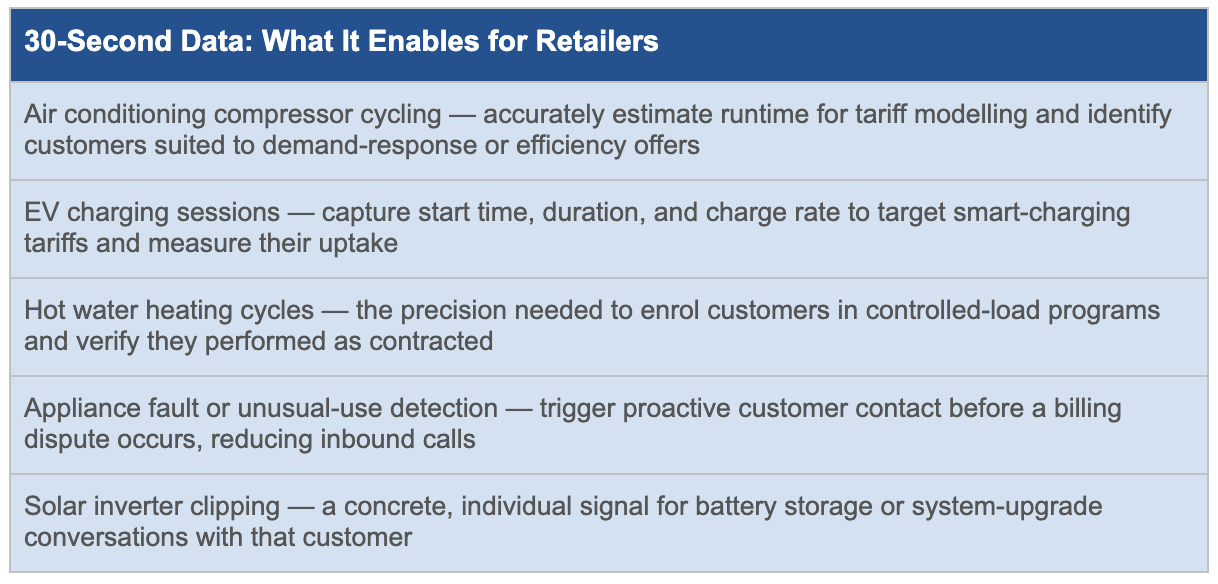
In each case, the output is not a network insight, it is a retail action. An offer, an enrolment, a verification, or a customer conversation. The 30-second resolution is what makes that action accurate enough to trust and fast enough to be useful.
2.2 Site-Level Data Including Gross Solar
Standard smart meters and many monitors measure only net import and export — what flows across the grid boundary. Powersensor measures gross solar generation separately from household consumption. This distinction is commercially significant because it turns a household's energy profile into a set of qualified sales signals, not just an analytics curiosity.
Gross solar and site-level data allows retailers to:
- Calculate true solar self-consumption ratios at the individual household level
- Identify customers who would benefit from battery storage and quantify the value
- Validate solar system performance against expected generation curves
- Design and measure behind-the-meter optimisation programs with verified generation data
2.2.1 From Data to Revenue: Four Monetisation Pathways
For most retailers, the immediate commercial question is not ‘what does this data show’ but ‘what can we sell because of it’. Granular site, solar, and appliance data turns generic cross-sell campaigns into targeted, individually-justified offers and gives the sales conversation a concrete, customer-specific number to anchor on.
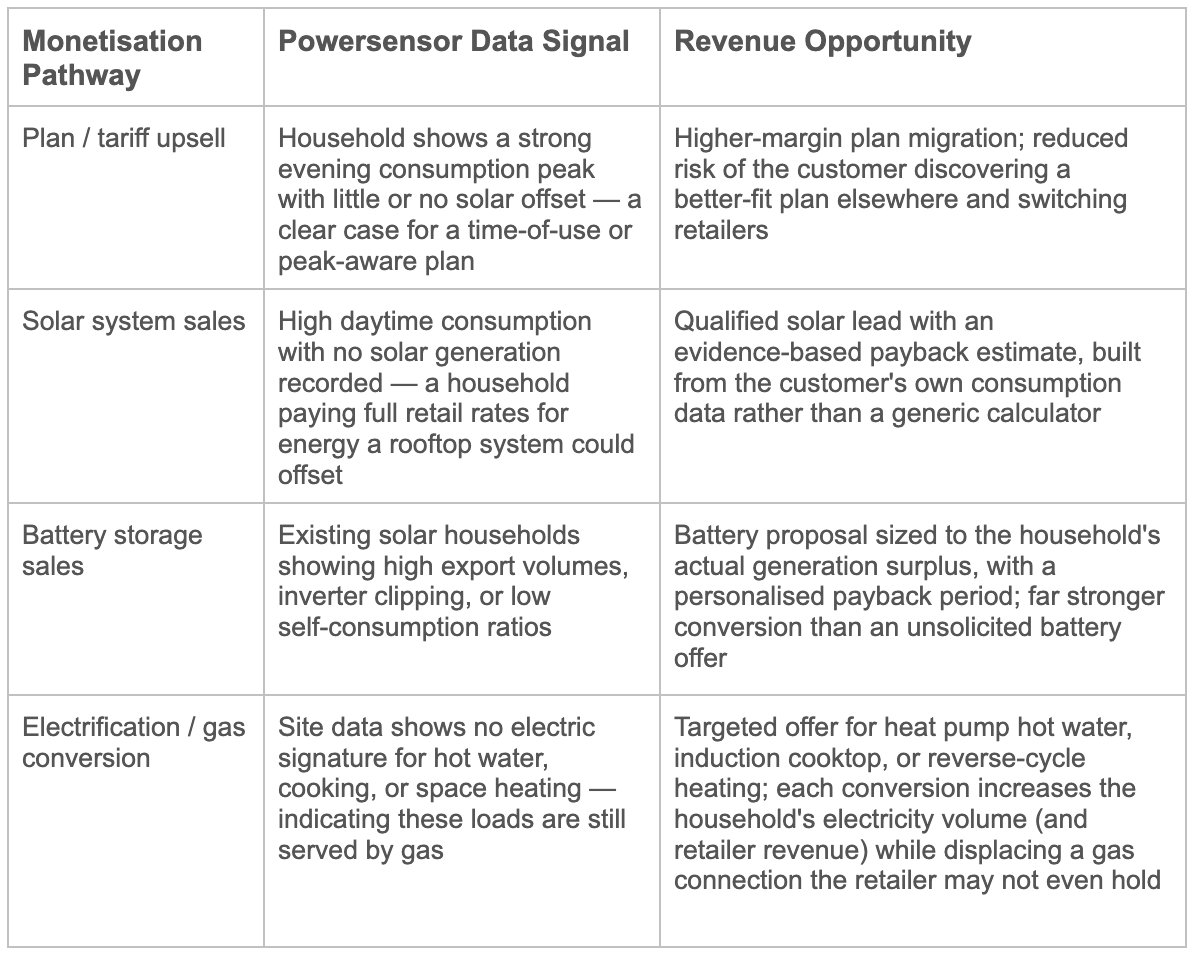
In each case, Powersensor data does not just identify that an opportunity exists, it identifies which specific households the opportunity applies to, and provides the evidence to make the offer credible. This converts cross-sell from a broad, low-conversion campaign into a targeted program with a materially higher hit rate per contact.
For households with solar — a fast-growing segment across all Australian states — this is the difference between a retailer that can make a credible, individually-tailored offer and one sending the same generic email to its entire customer base.
2.3 Behind-the-Meter Appliance Monitoring
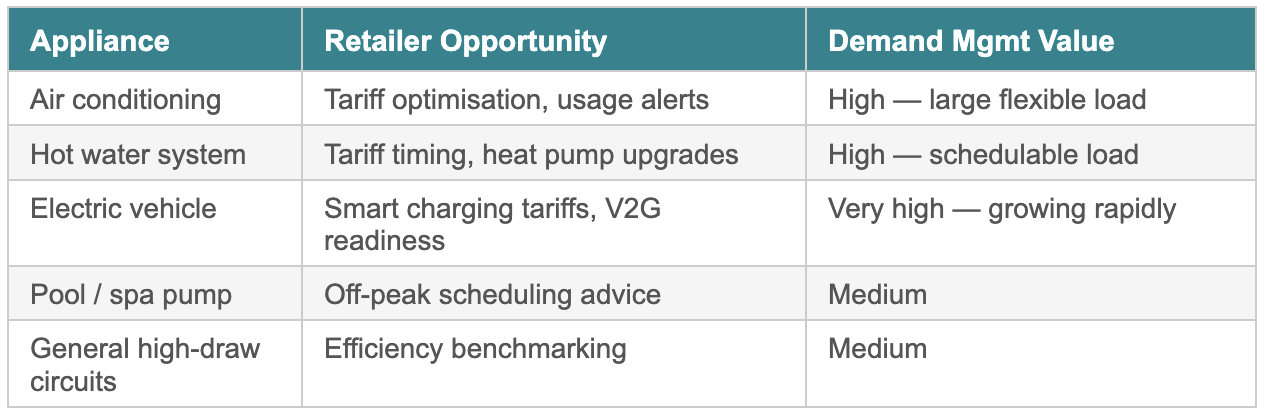
Powersensor's sub-circuit monitoring tracks individual appliances, typically the highest-value energy loads in the home. No hub device, no professional installation, no electrician required.
Key appliances covered include:
2.3.1 From Appliance Data to Program Revenue
Just as site and solar data convert into sales opportunities (Section 2.2.1), appliance-level data converts into program participation and ongoing revenue. Each identified appliance signal corresponds to a specific retailer action — an enrolment, a tariff offer, an upgrade conversation, or a service lead — with its own revenue or cost-saving driver.
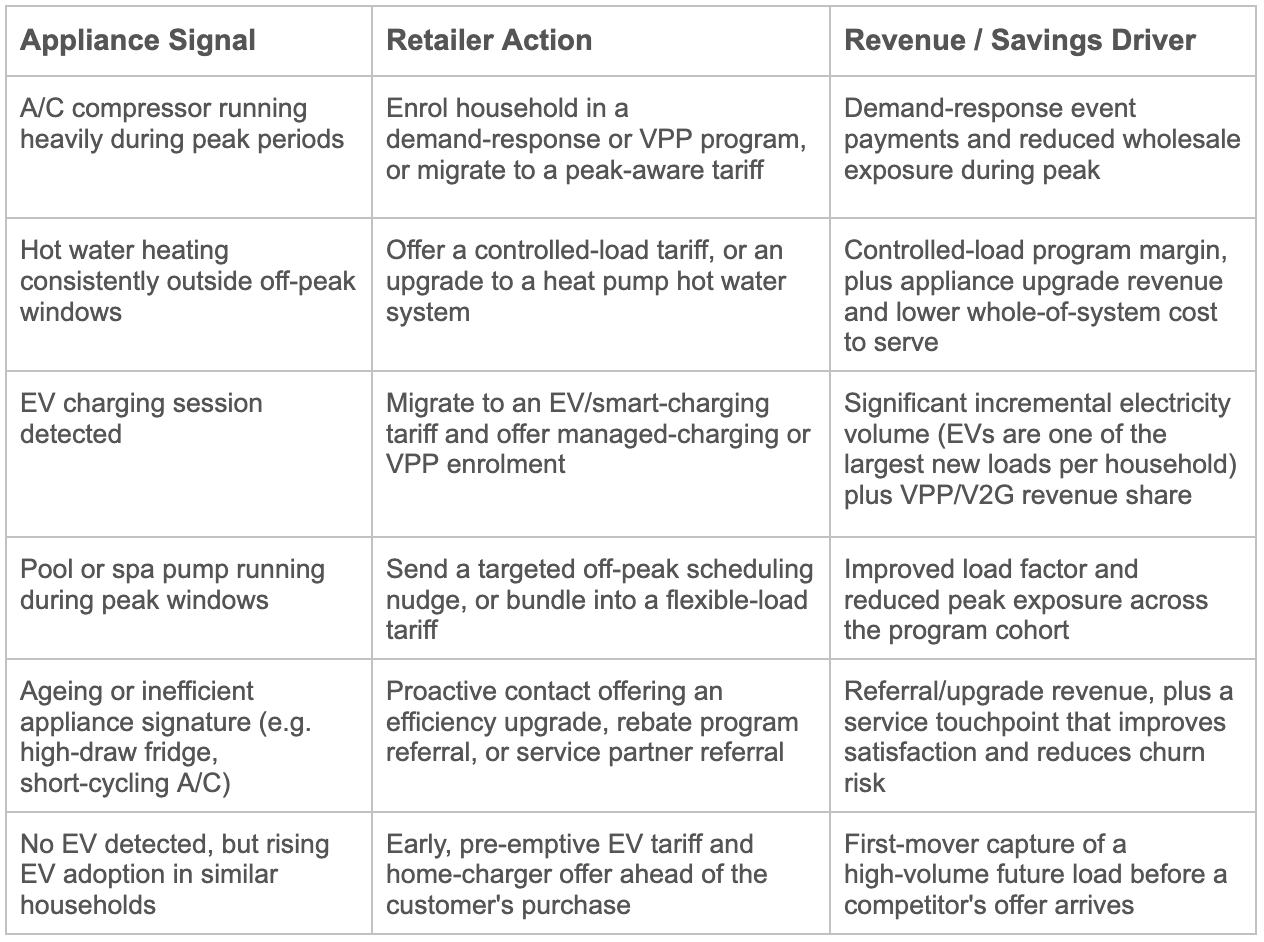
The common thread across all six pathways is that appliance-level data converts a generic program (‘join our demand response scheme’, ‘consider an EV tariff’) into a targeted, individually-justified one (‘your hot water system runs at 6pm, here is what switching to off-peak would save you, and what it is worth to us as a program participant’). That shift in specificity is what drives enrolment rates, programme retention, and the unit economics of demand-side programs.
2.4 Fully DIY — No Electrician Required
This is perhaps Powersensor's most commercially important attribute for retailers. Installation requires no licensed electrician, no booking lead time, and no on-site visit. The customer installs it themselves in under 30 minutes.
For a retailer, this means:
- No installation fulfilment complexity — no trades network to manage
- Rapid time-to-data — customers are live within the same day
- Low barrier to trial — the $200–$400 price point is accessible without subsidy
- Scalability — distribution through retail channels or direct-to-customer without logistics overhead
2.5 Beyond Sensor Data: Customer-Supplied Context
Sensor data alone tells a retailer what a household is doing. Powersensor's companion app adds the context that turns raw consumption signatures into labelled, actionable customer records. That information is captured directly from the customer at setup, with no additional effort required from the retailer.
At installation, customers provide:
- Current retailer and plan/tariff details — the customer's existing retailer and tariff structure, entered during app setup. For a retailer running this program, this is a direct view of competitor exposure across their prospect base, and a precise basis for a like-for-like switching offer rather than a generic ‘switch and save’ campaign.
- Property location — the customer's location, enabling postcode- and feeder-level segmentation, weather-correlated load analysis, and alignment of demand-side programs with specific network zones.
- Appliance identification — the customer labels each monitored circuit with the appliance type and, where known, make and model (e.g. ‘ducted reverse-cycle air conditioner’, ‘heat pump hot water system’). This converts an anonymous load signature into a named, specific asset — sharpening every upgrade, efficiency, and demand-response offer described in Sections 2.2.1 and 2.3.1.
- Appliance geolocation — captured via the customer's phone at setup, confirming each monitored appliance is physically located at the monitored premises. This supports data integrity for program verification and is useful for customers managing energy across more than one property.
None of this context requires the retailer to run a survey, conduct a site visit, or maintain a separate appliance register. It arrives bundled with the sensor data, collected once by the customer at the point of installation, and is immediately available to sharpen segmentation, targeting, and program design across every use case in this white paper.
3. Retailer Use Cases
3.1 Demand Response and VPP Program Recruitment
In practice, demand response and VPP participation at the residential level is a commercial choice, not a compliance obligation. An increasing number of retailers are making because the underlying economics have become compelling. Retailers that contract for demand response do so to manage their own wholesale price exposure during peak periods, and to capture revenue available through network support markets as distributed energy resources continue to grow. This is the same logic that drives any retailer to hedge: it is a margin and risk-management decision, made because it improves the P&L, not because a regulator requires it.
The problem most retailers face is not motivation, it is precision. Demand response programs are most effective when they target customers with the right loads at the right time. Today, most retailers recruit for demand programs using smart meter interval data and statistical modelling, an imprecise method that leads to over-recruitment of ineligible customers and under-recruitment of high-value flexibility assets.
With Powersensor data, retailers can identify customers with:
- Hot water systems running during peak periods; enrol them in a controlled load or demand response program
- EV chargers active in the 4–8pm window; offer smart charging tariffs or VPP participation
- Air conditioning loads above a threshold during demand events; target them for automated response
Post-event, 30-second data allows precise verification of whether the response actually occurred and at the appliance level, not just at the grid meter. For a retailer already running or considering a demand response or VPP program for commercial reasons, this turns a program built on imprecise targeting into one built on verified, appliance-level performance. The result is a stronger return on investment.
3.2 Personalised Tariff and Product Recommendations
Generic tariff advice has limited commercial impact. Powersensor enables retailers to build individual household energy profiles — when loads run, how much they consume, and how they interact with solar — and use these to make highly specific product recommendations. It is worth being explicit about which driver is doing the work in each case. Some recommendations are primarily revenue levers for the retailer, others are primarily retention levers, and a few are genuinely both. Conflating the two risks either overselling the customer-benefit story internally, or underselling the commercial case.
The table below makes the driver explicit for each example:
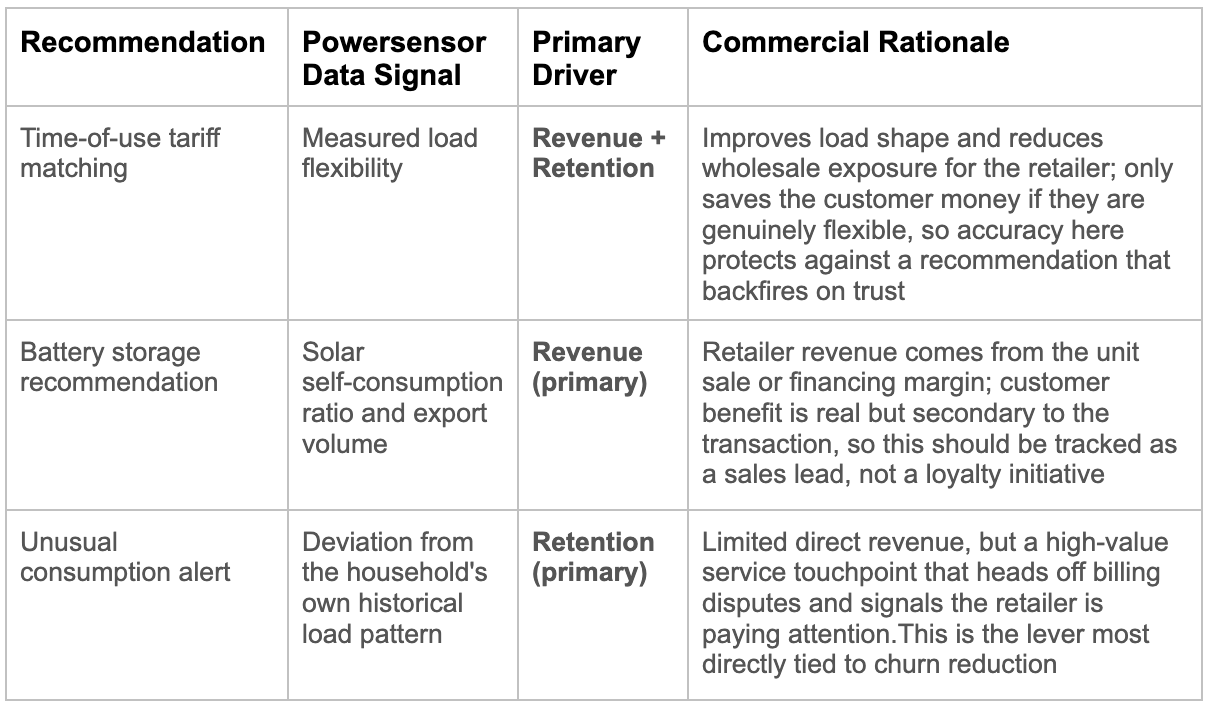
Recommendations that genuinely serve the customer and recommendations that primarily serve the retailer's margin can both be valid, but they should be measured against different success metrics. Tracking ToU and battery recommendations against revenue per customer, and consumption alerts against complaint volume and churn, gives a retailer an honest view of what this capability is actually delivering.
3.3 Customer Engagement and Churn Reduction
It is worth testing this hypothesis rather than asserting it. The intuitive claim is that customers who can see their energy data in real time become more engaged with their retailer, and that this engagement reduces churn. The evidence for this is real but conditional: it holds when the data the customer sees confirms they are being treated fairly, and it can work in the opposite direction when the data reveals they are not. A customer who logs into an app and discovers their usage is sensible and their tariff is competitive has more reason to stay. A customer who logs in and discovers a discount silently expired, or that a comparison site shows a better-fit plan elsewhere, has more reason — and now more evidence — to leave. Visibility cuts both ways; it does not automatically favour retention.
Powersensor data, surfaced through a retailer-branded app or portal, gives customers a reason to log in and a basis to act on advice. Whether that translates into retention or accelerated switching depends on what the retailer does with the visibility, not on the visibility itself.
The commercial implication is more nuanced than "engaged customers churn less." In a market where switching costs are low and price comparison is one search away, transparency is a retention lever only for a retailer whose underlying offer is genuinely competitive. In that case, the data becomes evidence the customer uses to justify staying. For a retailer relying partly on customer inattention — expired discounts, default tariffs after a promotional period, customers who simply haven't compared their plan in years — the same transparency can accelerate the realisation that they are paying too much, and accelerate churn rather than prevent it.
This is supported by evidence from outside the energy sector: the retention gains documented for engagement programs come specifically from proactive, personalised intervention ahead of a likely churn event, not from passive visibility alone. One often-cited case reduced churn by 15 percentage points using this kind of targeted intervention — a meaningfully different mechanism from simply giving a customer an app and assuming engagement follows. The implication for this white paper's retention case is that Powersensor data delivers its retention value when retailers act on it proactively, flagging a fair deal before the customer goes looking, not merely making usage visible and hoping the customer likes what they see.
4. The Commercial Case for Retailers
Data Value: What Is It Worth?
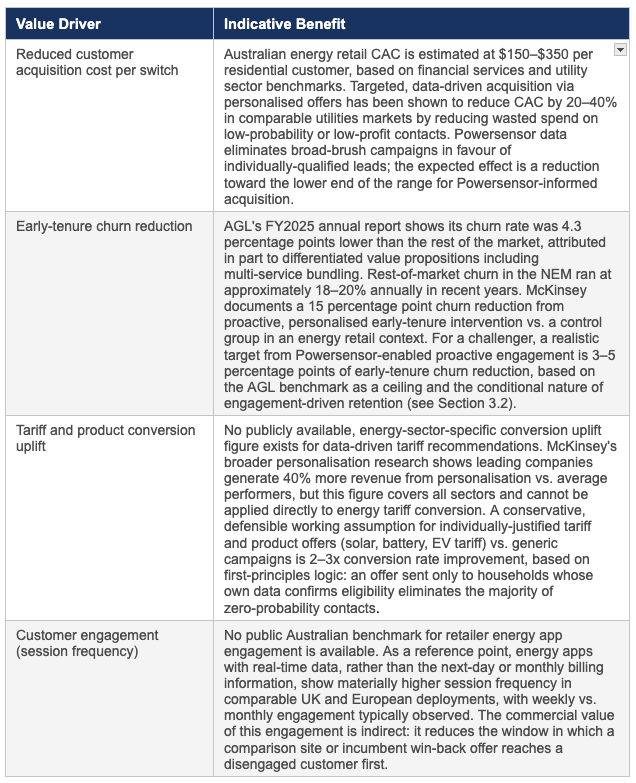
The value of Powersensor data to a challenger retailer depends on the programs built around it, but indicative value drivers include:
Competitive Differentiation
No competing DIY energy monitor in the Australian market combines 30-second resolution, gross solar measurement, and behind-the-meter appliance circuit monitoring at this price point with a no-electrician-required installation. This is not an incremental improvement, it is a different category of product.
Retailers who build their customer energy platform around Powersensor data will have a structural data advantage over competitors relying solely on smart meter interval data — an advantage that compounds over time as the installed base grows.
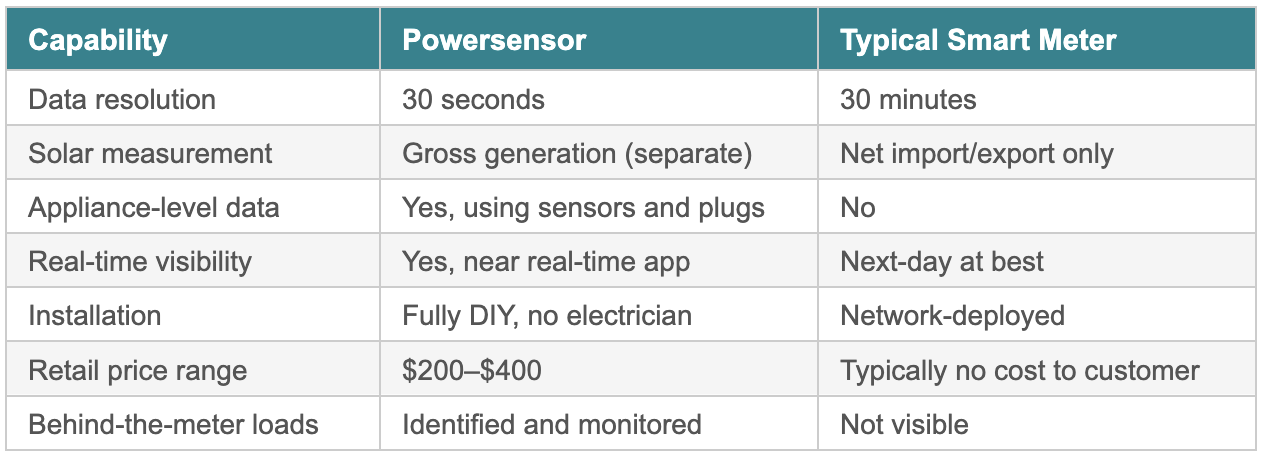
5. Technical Capability Summary
6. Next Steps
Powersensor is seeking retail distribution and integration partnerships with Australian energy retailers who want to lead on customer data capability. We are open to a range of commercial models, from standard wholesale supply to deeply integrated data-sharing arrangements.
We invite you to:
- Request a product demonstration and data dashboard walkthrough
- Discuss integration options with your customer energy platform or app
- Explore a pilot program, subsidised distribution to a targeted customer cohort with shared program outcomes