How a low-cost, self-installed energy monitor lets challenger and Tier 2 retailers compete on customer insight and personalisation, without the balance sheet of a Tier 1 incumbent.
Executive Summary
Customer switching in Australia's energy market recently reached a record 24.4% across the NEM. The largest single shift in that switching has been customers moving away from the “big three” (AGL, Origin, EnergyAustralia) toward tier-2 and challenger retailers. For the first time, the big three no longer hold the three largest market shares in South East Queensland or South Australia.
This is the opening every challenger retailer has been waiting for. Capturing it, however, requires giving customers a reason to choose you specifically, not just a reason to leave their current provider.
Price alone is a fragile differentiator because any competitor can match a discount. Genuine personalisation — knowing a customer's home, their appliances, their solar, their flexibility — is much harder to replicate. It is exactly what the big three's scale has historically made it hard for smaller retailers to deliver.
Powersensor is a fully DIY, self-installed energy monitor with a retail price from $200 AUD. It captures 30-second resolution data at the site level, including gross solar generation and behind-the-meter sub-circuit monitoring of major appliances such as air conditioning, hot water systems, EVs, and pool pumps. Critically for challenger retailers, none of this requires the multi-year platform investment, electrical network, or smart-meter-scale infrastructure that a Tier 1 incumbent might deploy. It is a data capability a challenger can switch on in weeks, not years.
For challenger and tier-2 retailers, Powersensor delivers four strategic advantages:
- Differentiation without the incumbent's balance sheet — match or exceed Tier 1 personalisation capability at a fraction of the capital outlay, with no electrician network, no hardware logistics, and no multi-year build (Section 2).
- Targeted tariff, solar, battery, and electrification sales — turn a limited marketing budget into individually-justified offers backed by a customer's own consumption data, competing on relevance rather than just price (Section 3.1).
- Churn reduction through genuine engagement — give newly-switched customers an early, tangible reason to stay, at the exact moment they are most likely to compare you against the incumbent they just left (Section 3.2).
- Demand response and VPP program precision — build a credible flexibility offering without requiring Tier 1-scale portfolio exposure, recruiting and verifying the right households rather than guessing at scale (Section 3.3).
This white paper sets out why this data matters specifically for a challenger brand, the product differentiators behind it, and the commercial case for making Powersensor part of your customer proposition.
1. The Data Gap — and Why It Hits Challenger Brands Hardest
Smart Meters Are Necessary But Not Sufficient
The rollout of smart meters across Australia has given every retailer, regardless of size, access to 30-minute interval data. On paper, this looks like a level playing field. In practice, it isn't. Smart meter data shows total consumption and export at the grid connection point — nothing more — and what a retailer does with that limited data depends heavily on the analytics, CRM, and personalisation infrastructure built around it. Tier 1 retailers have spent years and substantial capital building that infrastructure. Most challenger and tier-2 retailers have not, and building it from scratch is slow and expensive.
This means the real gap challenger retailers face is not just a data gap, it is a capability gap. Smart meter data alone cannot answer the questions that matter most for winning and keeping a customer:
- How much of a household's solar is being self-consumed versus exported?
- Is that peak demand event driven by air conditioning, EV charging, or the hot water system?
- When does this customer's dishwasher actually run and could it shift to off-peak?
- Did the customer respond to a demand-response event, and which appliance responded?
Without answers to these questions, a challenger retailer's offers, tariff recommendations, and demand programs are based on the same statistical inference a Tier 1 incumbents. The difference is that the challenger retailers have far less brand trust and far fewer existing customer touchpoints to fall back on when an offer misses the mark.
Why This Data Matters More for a Challenger Than an Incumbent
For a Tier 1 retailer, granular behind-the-meter data is an optimisation layer on top of an already large, profitable book of customers. For a challenger retailer, it is a strategic necessity. It is the only practical way to compete on something other than price against a competitor with vastly more capital, brand recognition, and customer data.
- From correlation to causation — A challenger cannot win a price war against a Tier 1 retailer's balance sheet. It can win a relevance war, but only if it actually knows which appliance is driving a customer's bill, not just that their usage spiked.
- From segment to individual — Generic, demographic-based offers are what a challenger competing purely on price already does, and what the incumbents already do better, at greater scale. Individual-level data is the one place a smaller retailer can out-personalise a larger one.
- From after-the-fact to real-time — A newly-switched customer's first weeks are the highest-risk window for them to switch straight back or to a third option. Near real-time data lets a challenger engage in that window before the incumbent's win-back offer arrives.
In short: for an incumbent, this data improves an already-strong position. For a challenger, it is one of the few realistic paths to a strong position in the first place.
Alternative Ways to Access This Data — and Why Powersensor Wins on Capital Efficiency
Granular behind-the-meter data is not unique to Powersensor in principle. In practice, the alternative approaches come with cost and capability requirements that a challenger retailer, without a Tier 1 balance sheet, usually cannot justify.
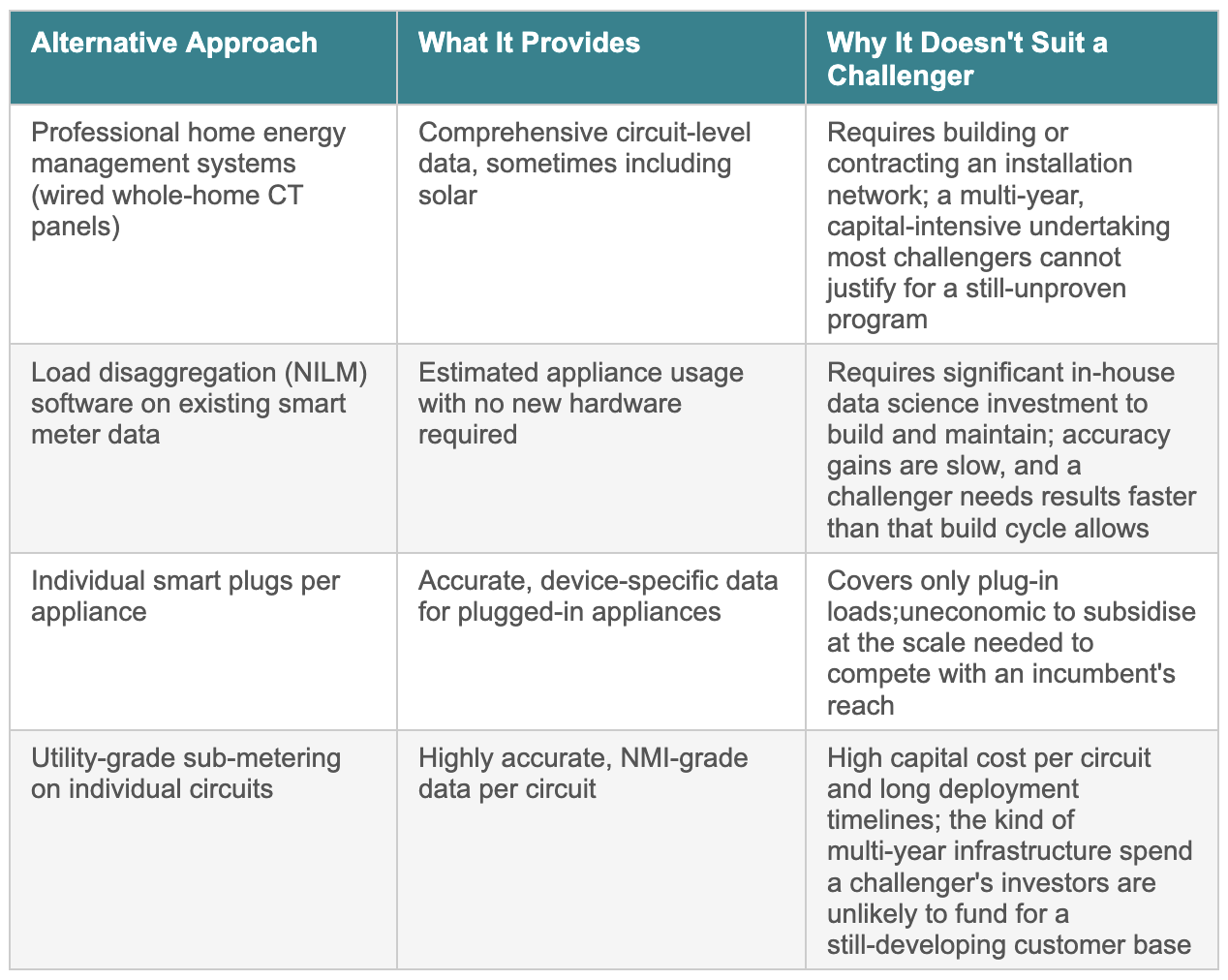
Powersensor is the only option that combines site-level consumption, gross solar generation, and major appliance data in a single device. It can be self-installed by the customer in under 30 minutes, doesn't require an electrician, and is available from $200 AUD. For a challenger retailer, this matters as much for what it removes as for what it adds. No installation network to build, no multi-year data science investment. It is a data capability that can be switched on with a product decision rather than a multi-year infrastructure program — putting genuine personalisation within reach of a retailer that could never have justified building it from scratch.
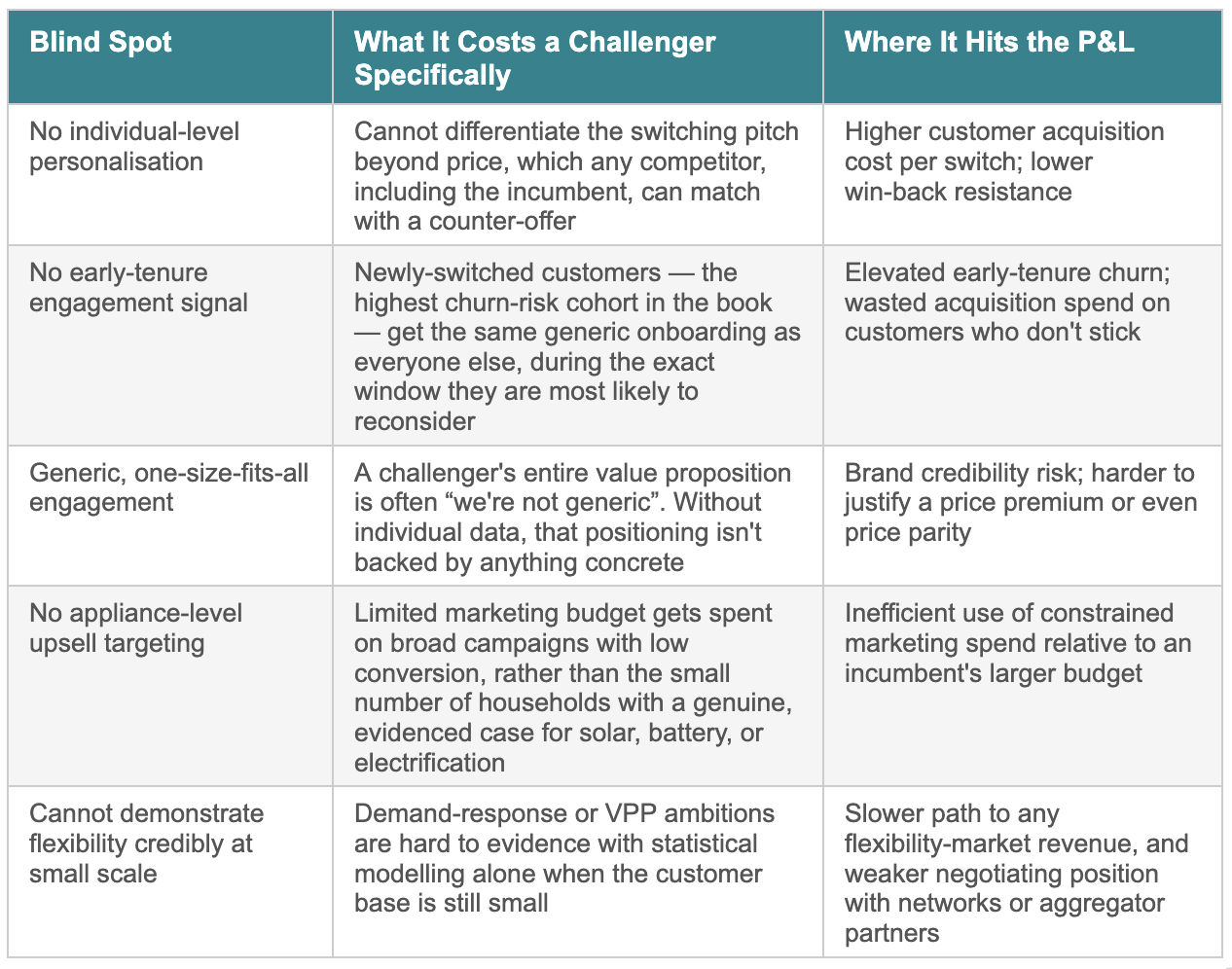
The Cost of Flying Blind — for a Challenger Specifically
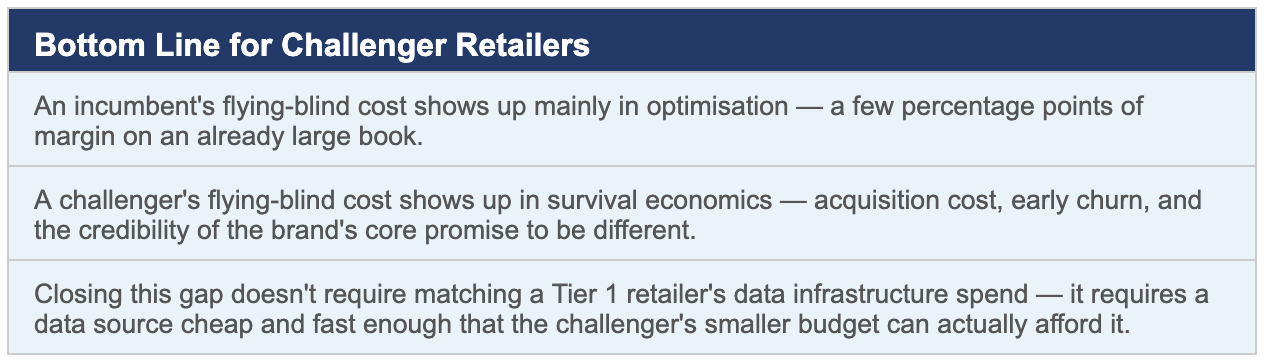
Every retailer pays a cost for lacking behind-the-meter visibility. For a challenger, that cost is weighted differently than for an incumbent.It shows up less in wholesale hedging precision (where Tier 1 retailers have the greater exposure) and more in the cost of winning and keeping customers in the first place.
2. What Makes Powersensor Different
2.1 30-Second Resolution — Personalisation a Challenger Can Actually Use
Powersensor captures data every 30 seconds, providing sufficient resolution to accurately identify individual appliances, rather than just overall trends.
This level of detail is sometimes associated with grid operations. For a challenger retailer specifically, its value is much more immediate. It is the resolution needed to make a switching pitch, an onboarding message, or a retention offer feel individually relevant from day one, without years of accumulated customer history that an incumbent has and a challenger does not.
Many high-value appliances — including reverse-cycle air conditioners, EV chargers, and hot water heat pumps — cycle their compressor load rapidly. A 5-minute average smooths these signatures into a flat line. At 30 seconds, they are clearly visible, attributable to a specific appliance, and usable in a retail workflow the same day a customer signs up.
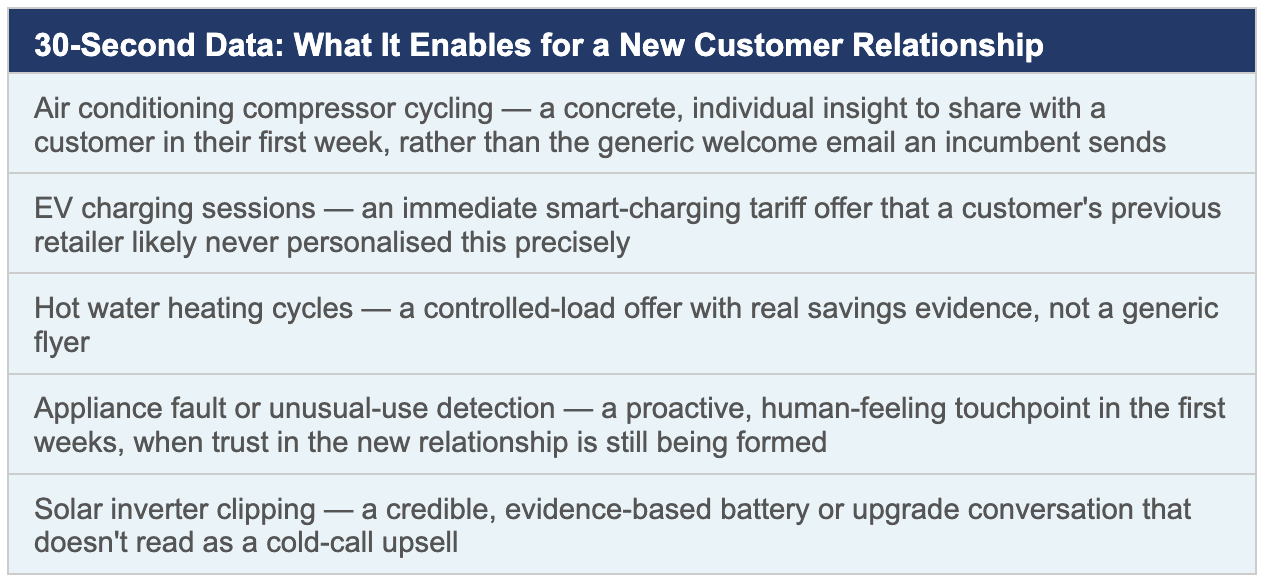
In each case, the output is not a network insight but a retail action. It lands at exactly the moment a challenger most needs it: in the early weeks of a new customer relationship, before the incumbent's win-back offer arrives.
2.2 Site-Level Data Including Gross Solar
Standard smart meters measure only net import and export, what flows across the grid boundary. Powersensor measures gross solar generation separately from household consumption. For a challenger retailer competing for solar households — often more engaged, more price-aware, and more willing to switch for a better-fit offer — this distinction turns a household's energy profile into a qualified sales signal.
Gross solar and site-level data allows a challenger retailer to:
- Calculate true solar self-consumption ratios at the individual household level
- Identify customers who would benefit from battery storage and quantify the value
- Validate solar system performance against expected generation curves
- Design and measure behind-the-meter optimisation offers with verified generation data
2.2.1 From Data to Revenue: Four Monetisation Pathways
For a challenger retailer with a constrained marketing budget, the key question is not just ‘what does this data show’ but ‘where should our limited spend go for the highest hit rate’. Granular site, solar, and appliance data turns a broad, low-conversion campaign into a small number of individually-justified offers. This is exactly the kind of efficient targeting a challenger needs when it cannot outspend an incumbent on volume.
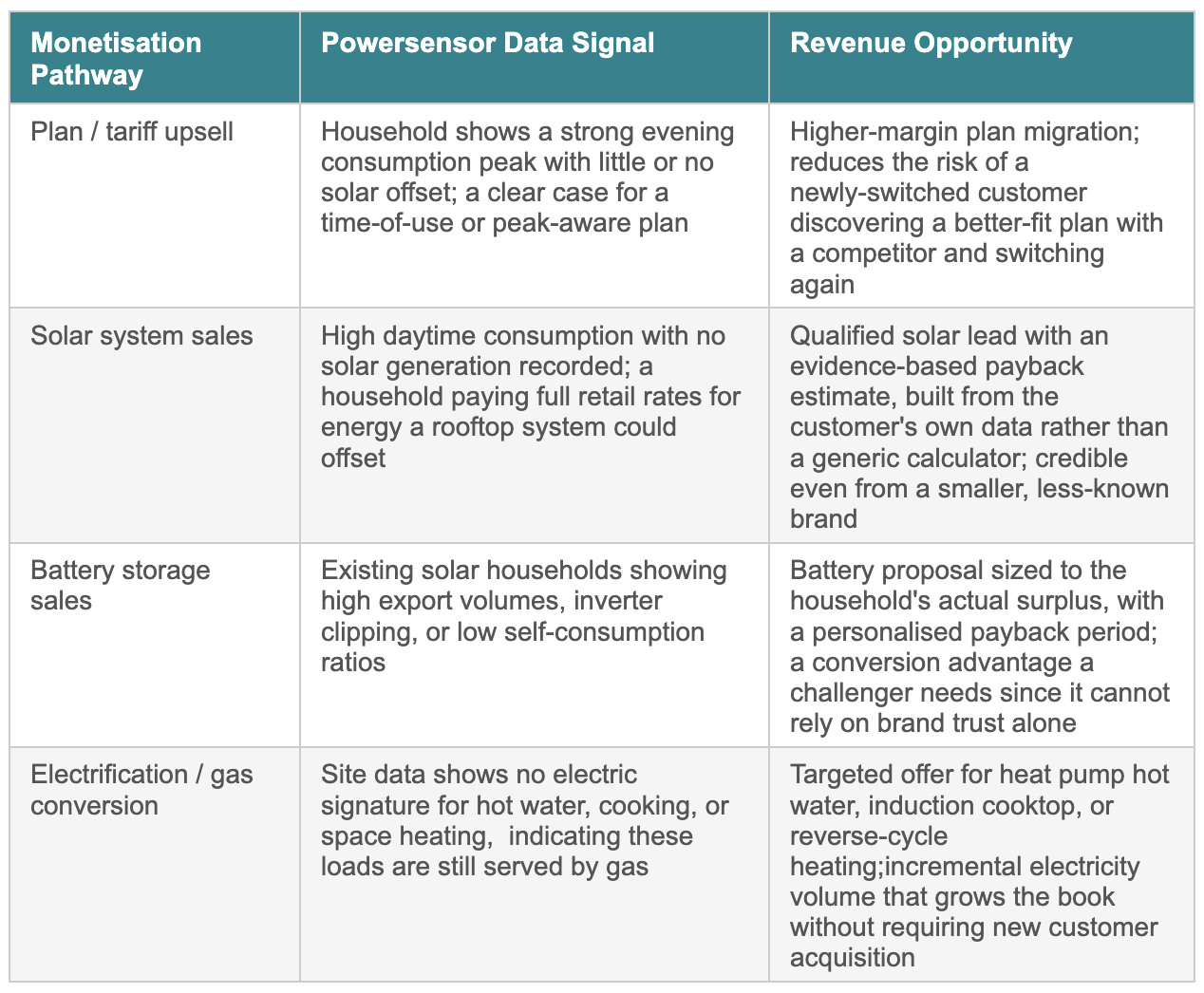
In each case, Powersensor data does not just identify that an opportunity exists;it identifies which specific households the opportunity applies to, allowing challenger retailers to focus their marketing spend where it is most likely to convert.
2.3 Behind-the-Meter Appliance Monitoring
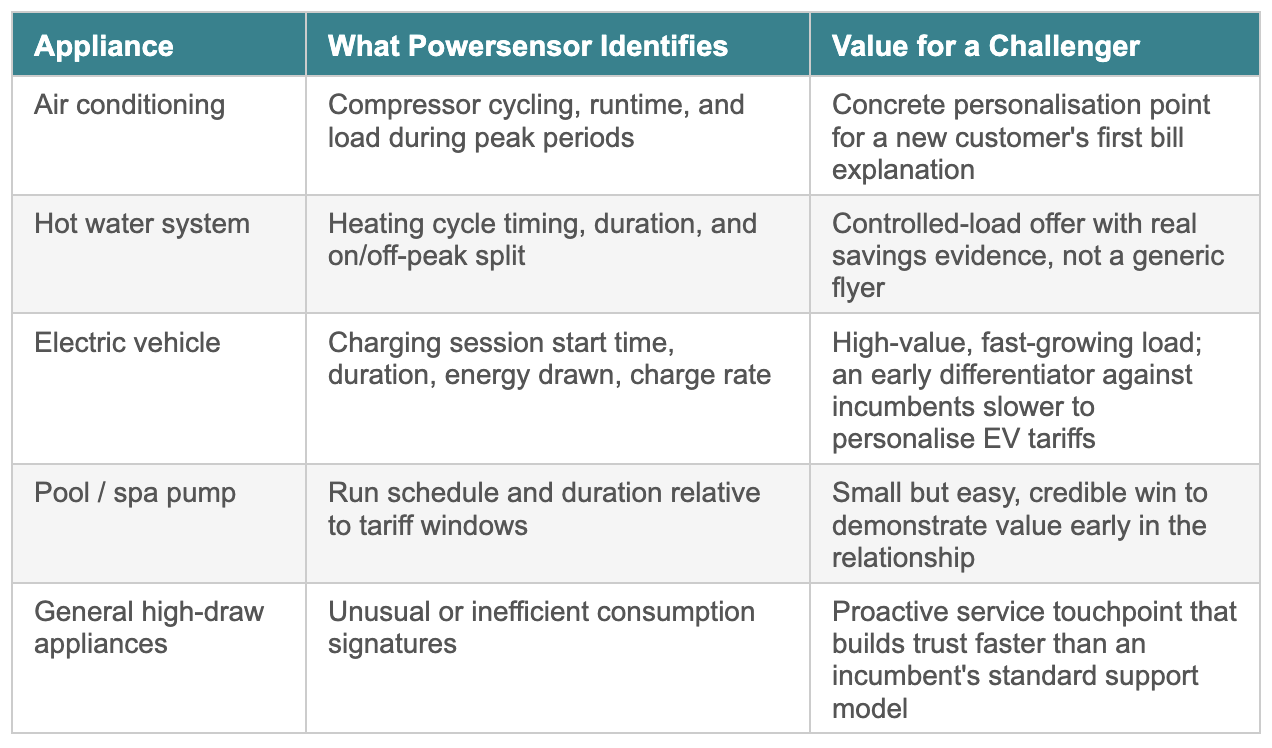
Powersensor's monitoring tracks individual appliances, typically the highest-value energy loads in the home. No hub device, no professional installation, no electrician required, which matters for a challenger retailer with no existing installation network to draw on.
Key appliances covered include:
2.3.1 From Appliance Data to Program Revenue
Just as site and solar data convert into sales opportunities (Section 2.2.1), appliance-level data converts into program participation and revenue, at a scale a challenger retailer can credibly support.

The common thread is that appliance-level data lets a challenger retailer make a specific, evidenced offer (‘your hot water system runs at 6pm, here is what switching to off-peak would save you’) instead of a generic one. That level of personalisation is much harder for a newer or smaller brand to manufacture without this data.
2.4 Fully DIY — No Electrician Required
This is arguably Powersensor's single most important attribute for a challenger retailer. Installation requires no licensed electrician, no booking lead time, and no on-site visit;none of which a smaller retailer typically has the infrastructure to arrange at scale. The customer installs it themselves in under 30 minutes.
For a challenger retailer, this means:
- No installation fulfilment complexity — no installation network to build or manage, which a challenger usually doesn't have
- Rapid time-to-data — a new customer is live within the same day, reinforcing the switching decision immediately
- Low barrier to trial — a retail price from $200 AUD is accessible without the kind of subsidy budget only a larger retailer could fund at scale
- Capital-light scalability — distribution through existing retail or digital channels without new logistics infrastructure
2.5 Beyond Sensor Data: Customer-Supplied Context
Sensor data alone tells a retailer what a household is doing. Powersensor's companion app adds the context that turns raw consumption signatures into labelled, actionable customer records. The information is captured directly from the customer at setup, with no additional retailer effort or back-office build.
At installation, customers provide:
- Current retailer and plan/tariff details — for a challenger, this is direct visibility into exactly which incumbent a switching customer is leaving and what they need to beat. It creates a precise basis for a like-for-like offer rather than a generic ‘switch and save’ campaign.
- Property location — enabling postcode- and feeder-level segmentation without needing a large existing customer base to draw statistical patterns from.
- Appliance identification — the customer labels each monitored point with the appliance type and, where known, make and model. This converts an anonymous load signature into a named asset, sharpening every upgrade, efficiency, and demand-response offer described in Sections 2.2.1 and 2.3.1.
- Appliance geolocation — captured via the customer's phone at setup, this confirms each monitored appliance is physically located at the monitored premises, supporting data integrity without requiring a verification team.
None of this context requires a challenger retailer to run a survey, conduct a site visit, or build a separate appliance register. It arrives bundled with the sensor data, collected once by the customer at the point of installation, giving a smaller retailer the same depth of customer context an incumbent might spend years and a dedicated analytics team accumulating.
3. Retailer Use Cases
3.1 Personalised Tariff and Product Recommendations
For a challenger retailer, generic tariff advice doesn't just have limited commercial impact, it actively undermines the brand's core promise of being different from the incumbents. Powersensor enables a challenger to build individual household energy profiles — when loads run, how much they consume, and how they interact with solar — and use these to make highly specific product recommendations from the very start of the relationship.
It is worth being explicit about which driver is doing the work in each case: some recommendations are primarily revenue levers, others are primarily retention levers, and a few are genuinely both. For a challenger working with a tighter budget than an incumbent, knowing which is which matters more, not less. Every dollar of marketing spend needs to be accountable to a specific outcome.
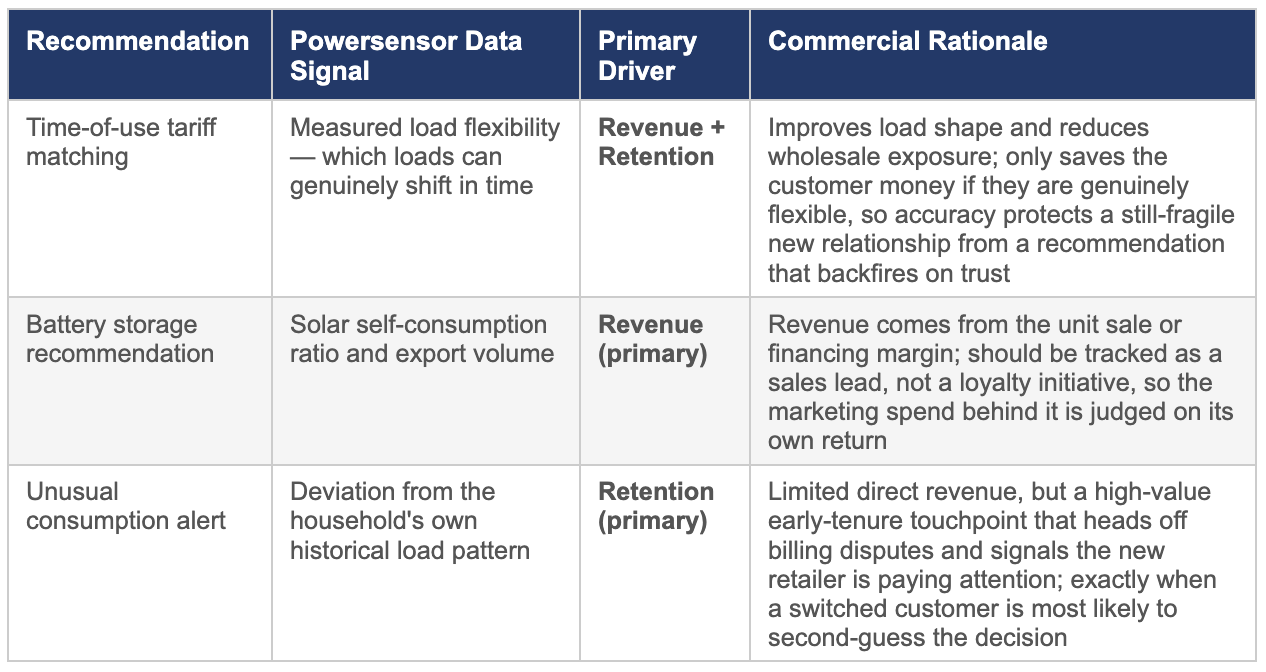
Recommendations that genuinely serve the customer and recommendations that primarily serve the retailer's margin can both be valid, but they should be measured against different success metrics. For a challenger, tracking ToU and battery recommendations against revenue per customer, and consumption alerts against early-tenure churn specifically, gives an honest view of what a constrained budget is actually buying.
3.2 Customer Engagement and Churn Reduction
The highest-risk period for any newly-switched customer is the first few months after they leave their previous retailer. This is when an incumbent's win-back offer is most likely to arrive, and exactly when a challenger has the least accumulated goodwill to rely on. It is worth testing the underlying hypothesis here rather than asserting it. Does giving a customer real-time visibility into their own energy data actually make them more likely to stay, or does it just as easily hand them the evidence to conclude they made the wrong choice and should switch again?
The honest answer is that it depends on what the data shows. A newly-switched customer who opens the app and sees their usage makes sense and their new tariff is genuinely competitive has a concrete reason to feel the switch was the right call. A newly-switched customer who opens the app and sees a usage pattern the new retailer hasn't actually priced well for, or who cross-checks against a comparison site and finds an even better deal, now has more reason — and more evidence — to switch a second time. For a challenger retailer specifically, this risk is amplified. Every customer in the book has already demonstrated a willingness to switch once, so the same transparency that builds trust when the offer is genuinely good can just as easily accelerate a second switch when it isn't.
This means the retention case for Powersensor data is conditional, not automatic. The evidence that supports it comes from proactive, personalised intervention. For example, one widely-cited case reduced churn by 15 percentage points by identifying at-risk customers and intervening before they churned, not by simply giving customers an app and assuming engagement would follow. For a challenger retailer, the practical implication is to use Powersensor data to proactively confirm and demonstrate a fair deal to a newly-switched customer, not merely to make usage visible and hope the customer likes what they see. Used this way, the data is a genuine retention asset; used passively, it is a coin flip that a switching-prone customer base can ill afford.
3.3 Demand Response and VPP Program Recruitment
In practice, demand response and VPP participation is a commercial choice for any retailer, and for a challenger specifically it is also a brand-building one: a credible flexibility offering signals technical sophistication that helps offset the trust gap with larger, longer-established incumbents. The constraint for most smaller retailers is not motivation, it is precision, and the confidence to recruit a program at a scale that fits a smaller customer base.
With Powersensor data, a challenger retailer can identify customers with:
- Hot water systems running during peak periods — and enrol them in a controlled load or demand response pilot
- EV chargers active in the 4–8pm window — and offer smart charging tariffs
- Air conditioning loads above a threshold during demand events — and target them for automated response
Post-event, 30-second data allows precise verification of whether the response actually occurred and at the appliance level, not just at the grid meter. For a challenger retailer building a flexibility offering from a smaller customer base, this verified, appliance-level evidence is what makes the offering credible to networks, partners, and customers alike, even without a Tier-1-scale portfolio.
4. The Commercial Case for Challenger Retailers
Data Value: What Is It Worth?
The value of Powersensor data to a challenger retailer depends on the programs built around it, but indicative value drivers include:

Competitive Differentiation — Specifically Against the Big Three
No competing DIY energy monitor in the Australian market combines 30-second resolution, gross solar measurement, and behind-the-meter appliance monitoring at this price point with a no electrician required. For a challenger retailer, the relevant comparison is not against other challengers. It is with the data and app capabilities of AGL, Origin, and EnergyAustralia, built over many years with substantially larger budgets.
Powersensor closes that capability gap without requiring the capital outlay, multi-year build, or platform team that a Tier 1 retailer used to get there. A challenger retailer who builds its customer proposition around Powersensor data can credibly offer a personalisation capability on par with, or in some respects beyond,the capabilities of the big three, at a fraction of the cost and in a fraction of the time.
5. Technical Capability Summary

6. Next Steps
Powersensor is seeking retail distribution and integration partnerships with Australian challenger and Tier 2 energy retailers who want to compete on customer insight and personalisation without matching a Tier 1 incumbent's data infrastructure spend. We are open to a range of commercial models, from standard wholesale supply to deeply integrated data-sharing arrangements sized appropriately to a smaller customer base.
We invite you to:
- Request a product demonstration and data dashboard walkthrough
- Discuss integration options with your customer engagement platform or app
- Explore a pilot program, subsidised distribution to a targeted cohort of newly-switched customers, sized to fit your current budget and customer base